Key Takeaways
- Pick a rated capacity at least 25% above the heaviest vehicle you will lift regularly.
- Measure ceiling height first: under about 3.9 m, choose a floor-plate, low-ceiling or short-post lift.
- Clear-floor lifts keep the floor open; floor-plate lifts need no overhead beam.
- Confirm power supply (220 V or 380 V, 50/60 Hz) and at least 150 mm of cured concrete before ordering.
A two post lift is the first piece of equipment most workshops buy, and it is the one technicians use most. Getting the specification right saves years of awkward workarounds. This guide walks through the six decisions that matter, in the order we ask our own customers.
1. Rated capacity
Start with the heaviest vehicle you expect to lift regularly, not occasionally. Add a margin of at least 25%. In practice that gives three bands:
| Workshop type | Typical vehicles | Recommended capacity |
|---|---|---|
| Home garage, tyre bay | Compact cars, sedans | 3,000–3,500 kg |
| General repair shop | Sedans, SUVs, light pickups | 4,000 kg |
| Fleet, van and light-truck service | Vans, LCVs, heavy SUVs | 5,000–6,000 kg |
Remember that capacity is rated with the load spread across all four arms. A vehicle with its engine removed, or a van loaded at the rear, shifts the centre of gravity — another reason to keep a margin.
2. Ceiling height
Measure the lowest point above the bay — beams, lights, garage door tracks, heaters. Then compare it with the column height of the lift:
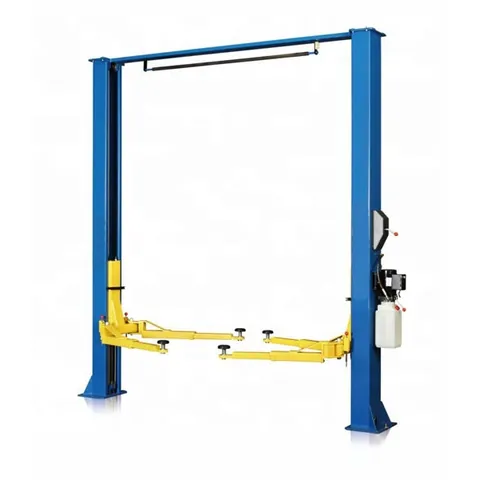
- Clear-floor (overhead beam) lifts usually need about 3.9–4.2 m.
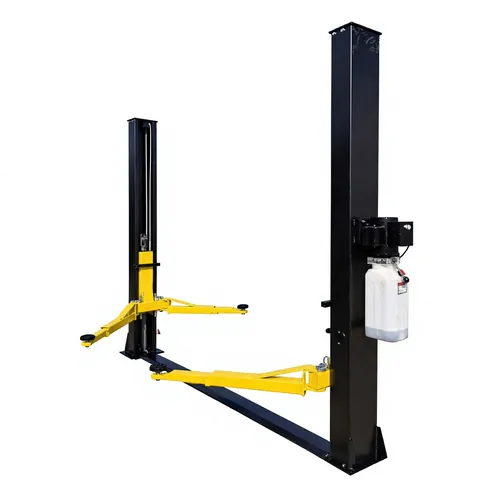
- Floor-plate lifts have no overhead beam and work under roughly 3.5 m.
- Short-post / low-rise lifts suit garages around 3.0 m and are ideal for wheel and brake work.
If the ceiling is low, a floor plate two post lift or our low ceiling two post lift is the safe choice.
3. Floor plate or clear floor
Both designs synchronise the two carriages with equaliser cables and carry the hydraulic hose from one column to the other. The difference is the route:
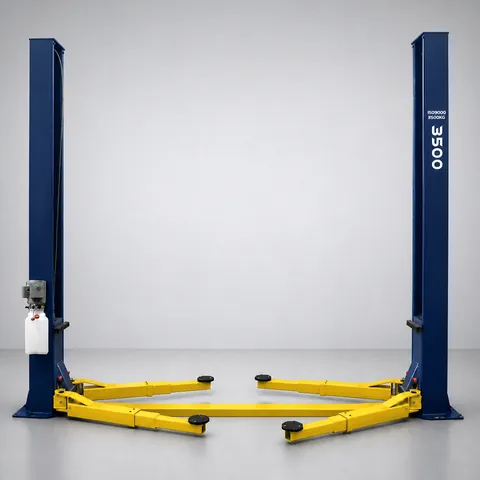
- Floor plate: cables and hose run under a low steel cover plate across the floor. No overhead beam, so tall vans fit — but there is a small ramp to roll over with transmission jacks.
- Clear floor: cables run through an overhead beam, leaving the floor completely open. An overhead shut-off bar stops the lift if the vehicle roof touches it.
4. Symmetric or asymmetric arms
Symmetric lifts position the vehicle centred between the columns, which suits long-wheelbase vans and trucks. Asymmetric lifts rotate the columns and use shorter front arms, so the vehicle sits further back and the doors open fully without hitting the columns. For a mixed passenger-car workshop, asymmetric is usually more convenient.
5. Power supply and lock release
Our two post lifts use a 2.2 kW power unit. Confirm the site voltage before ordering — 220 V single phase, or 380/415 V three phase — and the frequency (50 or 60 Hz). Manual lock release is simple and reliable; electric or pneumatic release lets one technician lower the lift from the control side.
6. Concrete and installation
Every two post lift is anchored to the floor, so the slab matters as much as the lift:
- At least 150 mm (6 in) thick, 3,000 psi / C25 concrete, cured for 28 days.
- No cracks, expansion joints or heating pipes within the column footprint.
- A level floor — shim plates correct small variations, not slopes.
See our detailed guide to concrete requirements for car lift installation.
Send us your ceiling height, bay width, power supply and typical vehicles and we will recommend a model and send a layout drawing — usually within one working day.
Quick checklist before you request a quote
- Heaviest vehicle and its weight
- Lowest ceiling point above the bay
- Bay width (minimum column-to-wall clearance)
- Voltage, phase and frequency
- Concrete thickness and age
- Preferred colour and whether you need your logo on the columns
FAQ
What is the most popular two post lift capacity?
4,000 kg (about 9,000 lbs) is the most common choice for general repair shops because it covers passenger cars, SUVs and light pickups with a safety margin.
Can a two post lift be installed outdoors?
Standard two post lifts are designed for indoor use. Outdoor installation needs a weather-protected power unit and regular corrosion protection; for parking outdoors, a dedicated parking lift is a better choice.